
Cockroach Janta Party Sparks Nationwide Gen Z Protests Over NEET Paper Leak Row
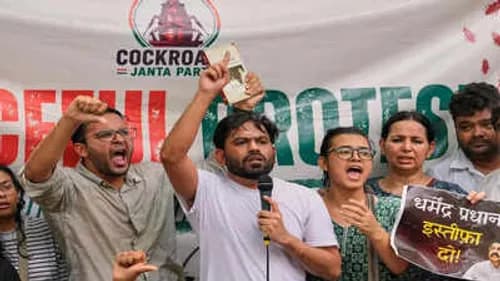
The Cockroach Janta Party has emerged as an unexpected symbol of youth frustration over examination irregularities and education reforms.
Executive Summary
The Cockroach Janta Party, a satirical youth-led movement, has gained national attention after launching protests demanding the resignation of Education Minister Dharmendra Pradhan following the NEET paper leak controversy. What began as an online joke has evolved into a broader expression of frustration among India's students and young voters.
Key Takeaways
- ✓The Cockroach Janta Party emerged following the NEET paper leak controversy.
- ✓The movement is demanding the resignation of Education Minister Dharmendra Pradhan.
- ✓More than 2 million students were affected by the NEET cancellation.
- ✓Social media has played a major role in the movement's growth.
- ✓The protest reflects broader frustrations among India's youth regarding education and accountability.
- ✓The coming days may determine whether the movement expands further nationwide.
Cockroach Janta Party Ignites Gen Z Protest Wave Across India Over NEET Paper Leak Crisis
A satirical political movement known as the Cockroach Janta Party (CJP) has rapidly become one of India's most talked-about youth-led protest campaigns, drawing attention to concerns over examination integrity, government accountability, and the frustrations of millions of students.
The movement emerged in the aftermath of the NEET examination controversy and has quickly gained traction across social media platforms, transforming internet satire into real-world activism.
What Triggered the Cockroach Janta Party Movement?
The immediate catalyst was the cancellation of the National Eligibility cum Entrance Test (NEET) following allegations of paper leaks and examination irregularities.
Key Facts About the NEET Controversy
- NEET was cancelled on May 12.
- More than 2 million students were affected.
- Allegations included paper leaks and examination misconduct.
- Students across multiple states expressed anger and uncertainty regarding their academic futures.
The controversy reignited broader concerns regarding the management of competitive examinations in India.
How the Cockroach Janta Party Began
The Cockroach Janta Party was launched on May 16 by Abhijeet Dipke, an Indian student based in the United States.
Initially conceived as a satirical response to political and judicial commentary surrounding the exam controversy, the movement quickly resonated with students frustrated by repeated examination irregularities.
Founder Background
- Founded by Abhijeet Dipke.
- Previously associated with political campaigning activities.
- Formerly worked with the Aam Aadmi Party (AAP) in a limited capacity.
- Built the movement primarily through social media engagement.
Why Gen Z Is Supporting the Movement
Many young Indians see the movement as a symbol of growing dissatisfaction with institutional failures affecting education and employment opportunities.
Major Student Concerns
Examination Integrity
Repeated incidents involving exam leaks have eroded trust in competitive testing systems.
Career Uncertainty
Students preparing for highly competitive exams often invest years of effort, making disruptions particularly damaging.
Accountability Demands
Many supporters argue that government officials should face greater accountability when large-scale examination failures occur.
Demand for Dharmendra Pradhan's Resignation
The movement's central demand is the resignation of Education Minister Dharmendra Pradhan.
Abhijeet Dipke has publicly given the minister a seven-day deadline to resign, arguing that the examination controversy has harmed an entire generation of students.
Protest Position
According to movement organizers, demonstrations will continue if the demand is not met within the specified timeframe.
Social Media's Role in the Movement
The rapid growth of the Cockroach Janta Party demonstrates the increasing influence of digital activism in India.
Platforms Driving Engagement
- X (formerly Twitter)
- YouTube
- WhatsApp communities
- Student discussion forums
Memes, satirical videos, and viral campaigns have played a significant role in expanding the movement's reach.
New Delhi Rally Draws National Attention
The movement's first public rally took place on June 6 in New Delhi.
Although attendance was reported at fewer than 2,000 participants, organizers argue that the demonstration generated substantial media coverage and increased public awareness.
Supporters view the rally as the beginning of a broader campaign rather than a measure of immediate political strength.
Political and Social Significance
The emergence of the Cockroach Janta Party highlights broader trends in Indian politics.
Changing Nature of Political Mobilization
Young voters are increasingly using humor, satire, and internet culture to engage with public issues.
Traditional political structures are facing competition from decentralized, digitally driven movements capable of reaching large audiences quickly.
Potential Impact on Education Policy
The controversy could accelerate discussions around reforms in examination administration and security.
Possible Areas of Reform
- Enhanced examination security systems.
- Digital monitoring mechanisms.
- Stricter anti-cheating measures.
- Greater transparency in testing procedures.
- Independent oversight mechanisms.
Economic and Market Implications
While primarily political and social in nature, the movement may also influence investor sentiment.
Areas to Watch
Education Sector
Companies involved in testing, educational services, and examination technology could face increased scrutiny.
Public Confidence
Large-scale student protests may contribute to broader debates about governance and institutional credibility.
Consumer Sentiment
Youth dissatisfaction can influence broader political and economic narratives, particularly ahead of major elections.
What Happens Next?
The next several days are expected to be crucial for the movement.
Observers will be closely monitoring:
- Government responses.
- Additional student demonstrations.
- Social media momentum.
- Potential policy announcements.
- The expiration of the resignation deadline.
Whether the movement evolves into a lasting political force or remains a symbolic protest campaign, it has already succeeded in bringing national attention to issues affecting millions of Indian students.
Reyansh
Political Affairs CorrespondentCredentials: FRM (Financial Risk Manager)
Reyansh tracks global geopolitical events and their direct impact on Indian market sentiment, specializing in risk management analysis.
