
Asteroids, Comets, and Meteors: Understanding the Ancient Objects Behind Shooting Stars
A shooting star marks the dramatic end of a journey that may have begun 4.6 billion years ago.
Executive Summary
The brilliant streaks of light commonly known as shooting stars are the result of ancient fragments from asteroids or comets entering Earth's atmosphere. These celestial objects are among the oldest remnants of the solar system, offering scientists valuable clues about planetary formation and the early history of our cosmic neighborhood. Understanding the differences between asteroids, comets, meteors, and meteorites helps explain some of the most spectacular astronomical events visible from Earth.
Key Takeaways
- ✓Asteroids and comets are ancient remnants from the formation of the solar system.
- ✓Asteroids formed in the inner solar system and consist mainly of rock and metal.
- ✓Comets formed in colder outer regions and contain significant amounts of ice.
- ✓Meteors are streaks of light created when space debris enters Earth's atmosphere.
- ✓Meteorites are fragments that survive atmospheric entry and reach the ground.
- ✓Meteor showers occur when Earth passes through comet debris streams.
- ✓The Perseid and Geminid showers are among the most popular annual meteor events.
- ✓India's growing space program is contributing to planetary science and astronomical research.
Asteroids Comets Meteors Meteorites: The Ancient Origins of Shooting Stars
Few sights in nature are as captivating as a shooting star racing across the night sky. While many people make wishes upon these fleeting streaks of light, the scientific story behind them is even more fascinating. The phenomenon often represents the final moments of a journey that began approximately 4.6 billion years ago, when the solar system itself was forming.
The study of Asteroids Comets Meteors Meteorites provides astronomers with a unique window into the earliest chapters of planetary history. These objects are among the oldest surviving materials in the solar system and contain clues about how planets, moons, and other celestial bodies emerged from clouds of dust and gas.
The Birth of the Solar System
Around 4.6 billion years ago, a vast cloud of gas and dust collapsed under gravity, forming the Sun and a rotating disk of material around it. Within this disk, tiny particles gradually collided and stuck together, creating larger bodies known as planetesimals.
Over millions of years, many of these planetesimals merged to form the planets we know today. However, some remnants survived and continue to orbit the Sun as asteroids and comets.
These ancient objects serve as time capsules from the earliest era of solar system formation.
What Are Asteroids?
Asteroids are rocky and metallic objects that primarily formed in the inner regions of the solar system.
Because temperatures near the young Sun were extremely high, volatile materials such as water ice could not survive. As a result, asteroids became composed largely of:
- Rock
- Metals
- Silicate minerals
- Nickel and iron compounds
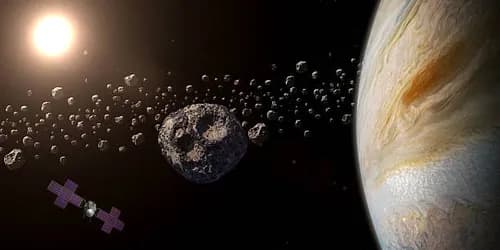
Many asteroids are found in the asteroid belt located between Mars and Jupiter. Their sizes range from small boulders to dwarf planet-sized bodies hundreds of kilometers across.
Scientists study asteroids to understand the building blocks that helped create Earth's terrestrial planets.
What Are Comets?
Comets formed much farther from the Sun, where temperatures were cold enough for water, methane, ammonia, and other frozen compounds to remain stable.
Because of their composition, comets are often called "dirty snowballs." They consist of:
- Rock
- Dust
- Frozen water
- Carbon dioxide ice
- Methane and ammonia compounds
When comets approach the Sun, heat causes their icy surfaces to vaporize. This process creates the glowing coma and distinctive tail that make comets among the most recognizable objects in the night sky.
Asteroids vs. Comets: Key Differences
Although both are remnants from the early solar system, important distinctions separate asteroids and comets.
| Feature | Asteroids | Comets |
|---|---|---|
| Formation Region | Inner Solar System | Outer Solar System |
| Composition | Rock and Metal | Rock, Dust, and Ice |
| Appearance | Solid rocky body | Glowing coma and tail near Sun |
| Typical Orbit | Relatively stable | Often elongated and elliptical |
| Scientific Importance | Planet formation clues | Early solar system chemistry |
Understanding these differences helps researchers reconstruct the environmental conditions that existed during the birth of the solar system.
What Creates a Shooting Star?
Despite their name, shooting stars are not stars at all.
A shooting star occurs when a small fragment of an asteroid or comet enters Earth's atmosphere at extremely high speed. Friction with atmospheric particles generates intense heat, causing the object to glow brightly and often vaporize.
This glowing streak is known scientifically as a meteor.
Most meteors are relatively small and burn up completely before reaching the Earth's surface.
What Is a Meteor?
A meteor is the visible flash of light produced when a space rock enters Earth's atmosphere.
As the object rapidly slows down and heats up, it creates a brilliant trail that can last from a fraction of a second to several seconds.
Millions of meteors enter Earth's atmosphere every day, although most are too small to be noticed.
Only a tiny fraction become bright enough to attract widespread attention.
What Is a Meteorite?
When part of a meteor survives its fiery journey through the atmosphere and reaches the ground, it becomes a meteorite.
Meteorites are scientifically valuable because they provide direct samples of ancient solar system material.
Most meteorites contain:
- Stone minerals
- Iron
- Nickel
- Mixed metal-rock compositions
Researchers often use laboratory analysis of meteorites to determine their age, composition, and origin.
Why Meteorites Are Difficult to Identify
Many people mistakenly believe they have discovered meteorites.
In reality, meteorites often resemble ordinary terrestrial rocks. However, scientists look for several characteristics:
- Unusual weight for size.
- Metallic content.
- Fusion crust from atmospheric heating.
- Irregular or pockmarked surfaces.
- Magnetic properties.
Proper identification usually requires detailed testing and expert analysis.
The Science Behind Meteor Showers
Meteor showers occur when Earth passes through streams of debris left behind by a comet.
As countless particles enter the atmosphere simultaneously, observers witness dozens or even hundreds of meteors per hour.
These annual events occur at predictable times because Earth crosses the same debris trails each year.
Meteor showers provide some of the most spectacular celestial displays visible without telescopes.
Famous Meteor Showers to Watch
Perseid Meteor Shower
The Perseids occur every August and are among the most popular meteor showers worldwide.
They originate from debris left behind by Comet Swift-Tuttle.
Under ideal conditions, observers can witness more than 100 meteors per hour.
Geminid Meteor Shower
The Geminids peak each December and are often considered the most reliable annual meteor shower.
Unlike many meteor showers that originate from comets, the Geminids are associated with an asteroid known as 3200 Phaethon.
Their bright and colorful meteors make them a favorite among skywatchers.
Why Scientists Study Asteroids and Comets
These ancient objects preserve information from the earliest stages of solar system history.
By analyzing their composition, scientists can better understand:
- Planet formation.
- Water delivery to Earth.
- Organic molecule distribution.
- Early solar system chemistry.
- Potential planetary defense threats.
Every meteorite recovered on Earth represents an opportunity to study materials older than our planet itself.
India's Growing Role in Planetary Science
India has become an increasingly important contributor to space exploration and astronomical research.
The Indian Space Research Organisation (ISRO) has expanded its scientific capabilities through missions such as:
- Chandrayaan-1.
- Chandrayaan-3.
- Mars Orbiter Mission (Mangalyaan).
- Aditya-L1.
Indian universities and research institutions are also conducting studies related to meteorites, asteroids, and planetary formation.
As India's space program continues to evolve, participation in future asteroid and planetary missions is expected to increase.
Looking Ahead
Advances in astronomy, spacecraft technology, and planetary science are enabling researchers to study asteroids and comets with unprecedented precision.
Future discoveries may reveal new insights into how the solar system formed and evolved. Upcoming meteor showers, newly discovered comets, and asteroid missions will continue to provide opportunities for both professional astronomers and amateur skywatchers.
The next time a shooting star flashes across the sky, it may represent the final chapter of an extraordinary journey that began billions of years before Earth itself became the world we know today.
Vivaan
Senior Science CorrespondentCredentials: Chartered Accountant (CA)
Vivaan specializes in corporate actions, IPO analysis, and capital market research. He is dedicated to making stock market concepts accessible to retail investors.
