
Helium-3 Moon Mining Gains Momentum as Demand Surges for Quantum Computing and Fusion
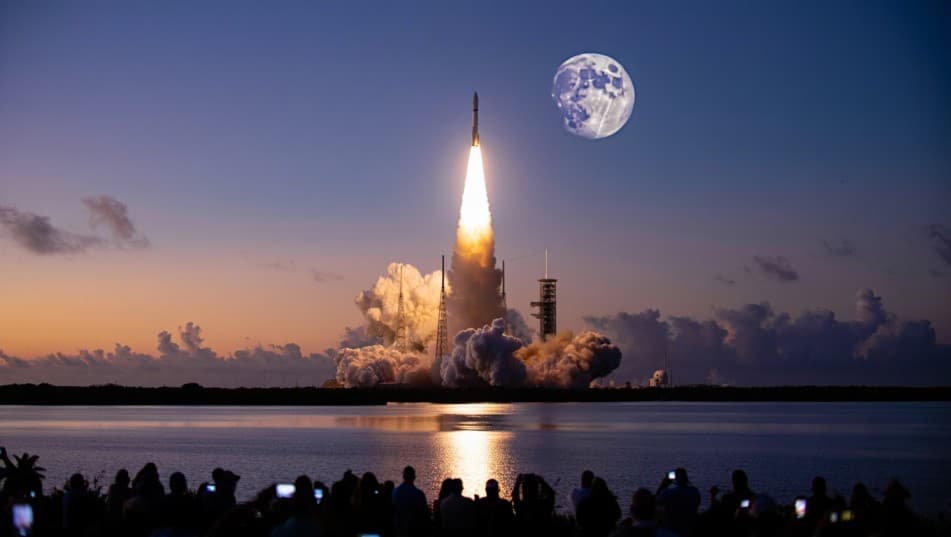
Companies are developing technologies to extract helium-3 from lunar soil as demand grows across advanced technology sectors.
Executive Summary
Helium-3, one of the world's rarest and most valuable gases, is attracting growing interest from technology companies, energy researchers, and space startups. With prices reaching approximately $2,000 per liter and demand expected to outpace supply, companies such as Interlune are exploring the moon as a potential source. The resource could play a critical role in the future of quantum computing, ultra-low temperature research, and nuclear fusion technologies.
Key Takeaways
- ✓Helium-3 costs approximately $2,000 per liter and remains extremely scarce.
- ✓Current supply primarily comes from tritium decay linked to nuclear weapons programs.
- ✓Quantum computing and nuclear fusion are major drivers of future demand.
- ✓The moon may contain significant helium-3 reserves within lunar regolith.
- ✓Interlune is developing technologies to extract helium-3 from the lunar surface.
- ✓Commercial extraction would require processing massive quantities of lunar soil.
- ✓India's growing space program could benefit from future lunar resource opportunities.
- ✓Helium-3 may become a strategic resource in the emerging space economy.
Helium-3 Moon Mining: The Race to Unlock the Moon's Most Valuable Resource
The global race for Helium-3 Moon Mining is accelerating as scientists, investors, and space companies search for new sources of one of the rarest materials on Earth. Valued at roughly $2,000 per liter, helium-3 has become increasingly important for emerging industries including quantum computing, advanced scientific research, and future nuclear fusion technologies.
Today, most helium-3 originates from the decay of tritium associated with nuclear weapons programs, making supply highly restricted and limited. As demand continues to rise, researchers are turning their attention toward an unlikely source: the moon.
What Is Helium-3?
Helium-3 is a rare isotope of helium containing two protons and one neutron. Unlike conventional helium, helium-3 possesses unique properties that make it highly valuable for scientific and industrial applications.
Scientists use helium-3 to create extremely low temperatures required for advanced experiments, quantum computing systems, and specialized detectors. It is also considered a potential fuel source for future fusion reactors due to its ability to generate energy with fewer radioactive byproducts than traditional fusion fuels.
Its rarity, however, remains one of the biggest challenges facing researchers and industries seeking to expand its use.
Why Is Helium-3 So Expensive?
Several factors contribute to helium-3's exceptionally high market value:
- Extremely limited natural supply on Earth.
- Dependence on tritium decay from nuclear weapons stockpiles.
- Growing demand from scientific and technology sectors.
- Complex extraction and purification processes.
- Strategic importance for future energy applications.
Current estimates place the price at approximately $2,000 per liter, although market conditions can cause significant fluctuations.
Current Sources of Helium-3
Most commercially available helium-3 comes from tritium decay associated with military nuclear programs.
Experts estimate that tens of thousands of liters are generated annually through this process. However, supply remains tightly controlled and insufficient to meet future demand from rapidly expanding technology industries.
As quantum computing and fusion research accelerate worldwide, concerns are growing that traditional supply channels may become inadequate.
Why the Moon Has Become a Target
For decades, scientists have theorized that helium-3 may exist in meaningful quantities within lunar regolith, the layer of dust and fragmented rock covering the moon's surface.
Unlike Earth, the moon lacks a strong magnetic field and atmosphere. Over billions of years, particles from the solar wind containing helium-3 have become embedded within lunar soil.
Analysis of samples returned during lunar missions suggests concentrations ranging from a few parts per billion to more than twenty parts per billion in certain regions.
Although these concentrations appear small, the sheer volume of lunar material has encouraged companies to investigate large-scale extraction possibilities.
Interlune's Ambitious Lunar Mining Plan
Seattle-based startup Interlune is among the companies leading efforts to commercialize helium-3 extraction from the moon.
According to co-founder and CEO Rob Meyerson, the company has spent several years developing, prototyping, and testing technologies designed specifically for lunar resource extraction.
Interlune plans to deploy autonomous excavators capable of:
- Scooping lunar regolith.
- Processing massive quantities of soil.
- Separating helium-3 from other materials.
- Preparing extracted resources for transport.
The company has assembled a growing team of engineers, scientists, and space industry specialists focused on transforming lunar mining into a commercial reality.
The Technical Challenges of Moon Mining
While the concept is promising, extracting helium-3 from the moon presents enormous engineering challenges.
Researchers estimate that enormous quantities of regolith would need to be excavated and processed to recover commercially useful volumes of helium-3.
Experts describe the undertaking as a "mountain-moving" operation due to the vast amount of material involved.
Challenges include:
- Operating machinery in extreme lunar temperatures.
- Managing energy requirements for processing regolith.
- Transporting equipment to the moon.
- Storing and transporting extracted helium-3.
- Maintaining autonomous operations far from Earth.
These obstacles mean commercial-scale extraction remains years away despite growing industry interest.
Impact on Quantum Computing
One of the most immediate drivers of helium-3 demand is the rapidly expanding quantum computing industry.
Quantum computers often require temperatures approaching absolute zero to function effectively. Helium-3 plays an important role in achieving and maintaining these ultra-cold environments.
As major technology companies continue investing billions into quantum research, demand for helium-3 is expected to increase substantially.
The availability of larger supplies could help accelerate breakthroughs in computing power, optimization, cryptography, and artificial intelligence applications.
Potential Role in Nuclear Fusion
Perhaps the most transformative application for helium-3 lies in nuclear fusion.
Fusion promises nearly limitless clean energy by replicating the processes powering the sun. Some proposed fusion designs use helium-3 because it produces fewer radioactive byproducts compared to other fusion fuels.
Although practical helium-3 fusion remains a long-term goal, successful lunar extraction could provide access to fuel sources that are currently unavailable on Earth.
This possibility has fueled significant interest among governments, energy researchers, and private investors.
Economic and Investment Implications
The emergence of helium-3 as a strategic resource could create entirely new markets within the global space economy.
Potential beneficiaries include:
- Lunar mining companies.
- Aerospace manufacturers.
- Quantum computing firms.
- Fusion energy developers.
- Robotics and autonomous systems providers.
Investors increasingly view lunar resource extraction as a long-term growth opportunity linked to both technological advancement and future energy infrastructure.
India's Opportunity in the Lunar Economy
India's expanding space ambitions make helium-3 an important topic for policymakers and industry leaders.
With successful lunar missions and a rapidly developing space ecosystem, India is positioning itself as a significant participant in future space-based industries.
Should commercial lunar mining become viable, Indian organizations could contribute through:
- Spacecraft development.
- Robotics and automation technologies.
- Lunar exploration missions.
- Resource extraction research.
- International partnerships.
The country's growing capabilities could enable participation in a future global market centered around lunar resources.
Outlook: A New Space Resource Economy?
The future of helium-3 moon mining remains uncertain but increasingly compelling. While significant technical, economic, and logistical hurdles remain, progress by companies such as Interlune demonstrates growing confidence in the commercial potential of lunar resources.
As demand from quantum computing, fusion research, and advanced scientific applications continues to rise, securing reliable supplies of helium-3 may become a strategic priority for both governments and private industry.
The coming decade could determine whether helium-3 transitions from a rare laboratory material into one of the most important resources driving the next generation of technology and energy innovation.
Ayaan
Senior Space and Technology CorrespondentCredentials: Certified Financial Planner (CFP)
Ayaan specializes in personal finance, mutual fund research, and retirement planning. He holds a deep interest in wealth creation strategies.
